
Six Nines
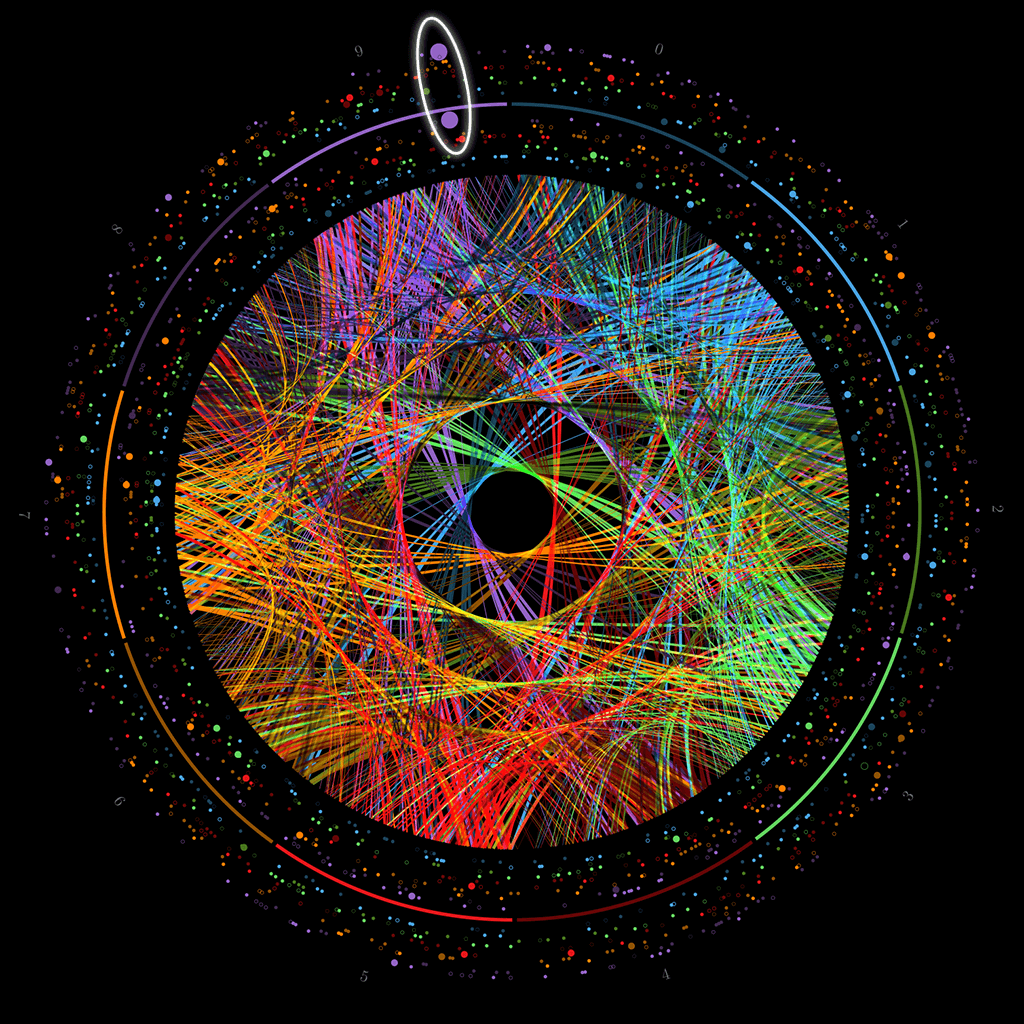
Still on a Hofstadter kick. It's Pi Day. Turns out they connect.
Starting at position 762, the decimal expansion of pi goes: ...999999... Six nines in a row.
This sequence is informally known as the "Feynman point." The story goes that Feynman wanted to memorize pi up to that spot, recite all 762 digits, hit the nines, and say "nine nine nine nine nine nine and so on".
Except it probably wasn't Feynman. The earliest known source is Hofstadter, in Metamagical Themas (1985):
I myself once learned 380 digits of π, when I was a crazy high-school kid. My never-attained ambition was to reach the spot, 762 digits out in the decimal expansion, where it goes "999999", so that I could recite it out loud, come to those six 9's, and then impishly say, "and so on!"
Before position 762, no digit in pi's decimal expansion appears more than three times in a row. Not four. Not five. The first time any digit manages four consecutive, five consecutive, or six consecutive appearances, it's nines. All at the same spot. A genuine mathematical coincidence.
And the joke only works with 9s. "...four four four four four four and so on" means nothing. Only 9s suggest the number is rational. Which it isn't. Which is the joke.
Update, October 2013: I stumbled upon this beautiful visualization by Martin Krzywinski. It's a circos diagram where the circle is divided into 10 segments (digits 0 through 9), and each digit of pi connects to the next with a line. The outer layer tracks transition counts: how often one digit follows another. Bigger dot means more frequent transition. The six consecutive 9s (999999) create five 9→9 transitions. In a circos transition diagram, each transition is recorded at both ends: the source and the destination. Since both the source and destination are the same segment (9→9), you get two large bubbles on the 9 segment, one for outgoing and one for incoming. Five transitions in quick succession inflates both.