Spin Doctor
Hard Drive Speakers
Update: See them play the legendary Second Reality demo by Future Crew.
The kids and I disassembled roughly 40 hard drives.
That's where this started. A pile of old drives, a box of Torx screwdrivers, and kids who were absolutely willing to take things apart.

The goal: build speakers from the drives. Actual stereo speakers, using the read/write head coil as a voice coil. Wire it to an amplifier. The actuator arm vibrates. It makes sound.
It works better than it should.
The idea wasn't original. People have been wiring drive coils to amps for years. A quick search turns up dozens of experiments, ranging from quick tests to proper tutorials to someone asking the obvious question out loud. One person even went further and attached a speaker cone to the actuator arm to improve output.
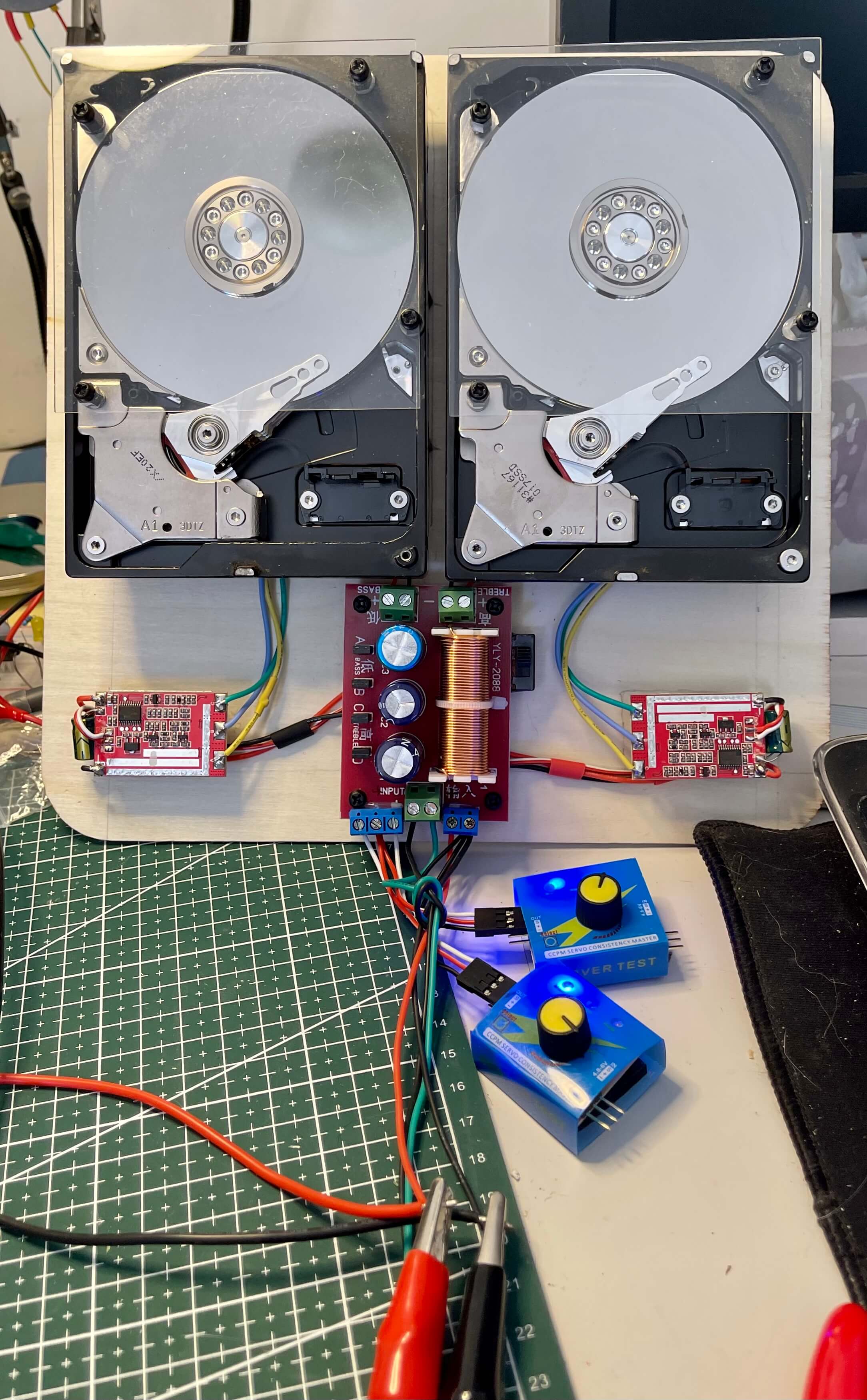
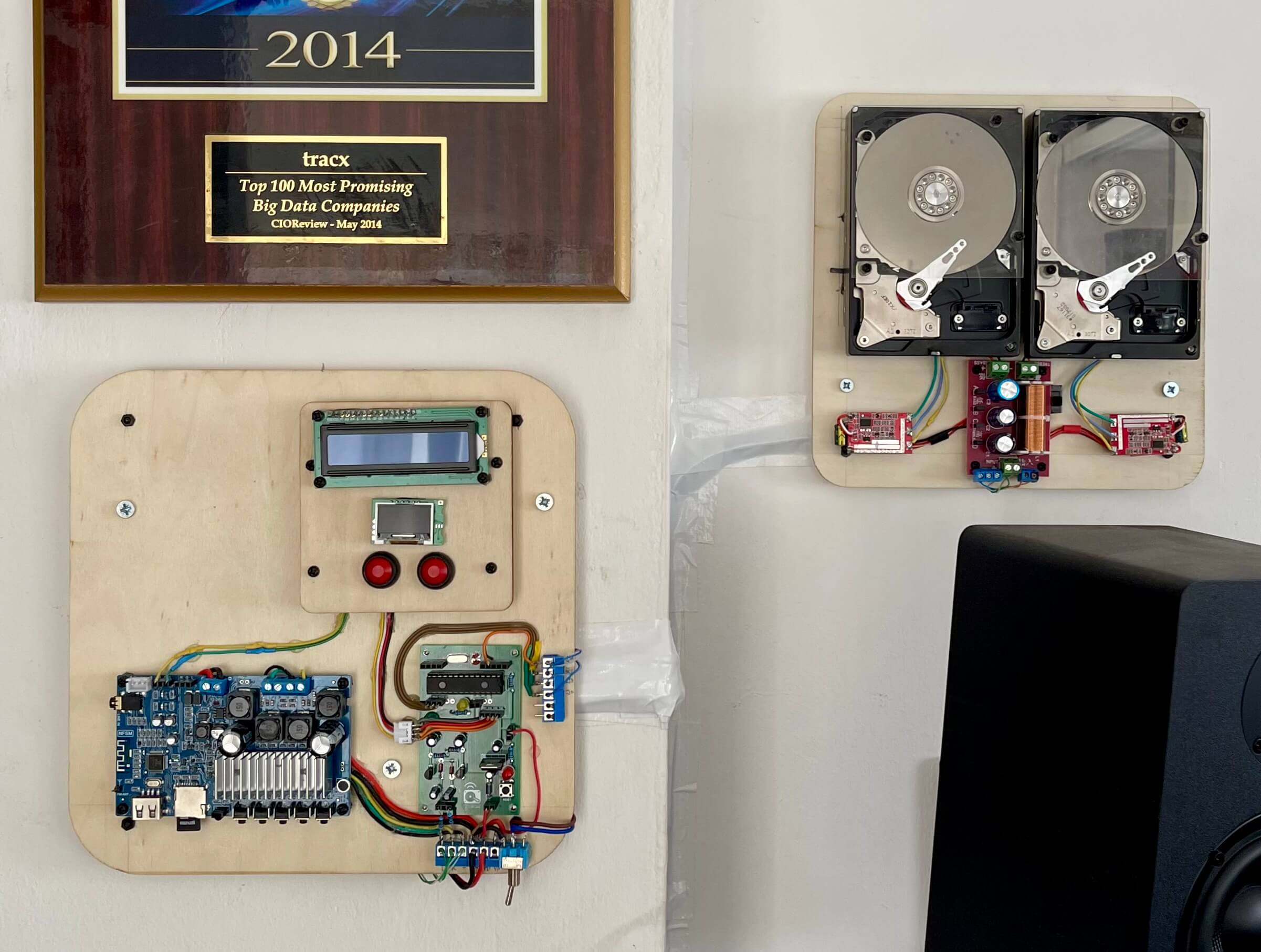
Each speaker is a pair of drives on a panel. One handles bass, one handles treble. A passive crossover splits the signal. The drives are open, covers removed, platters exposed. In the mockup iterations, the panels were wood.
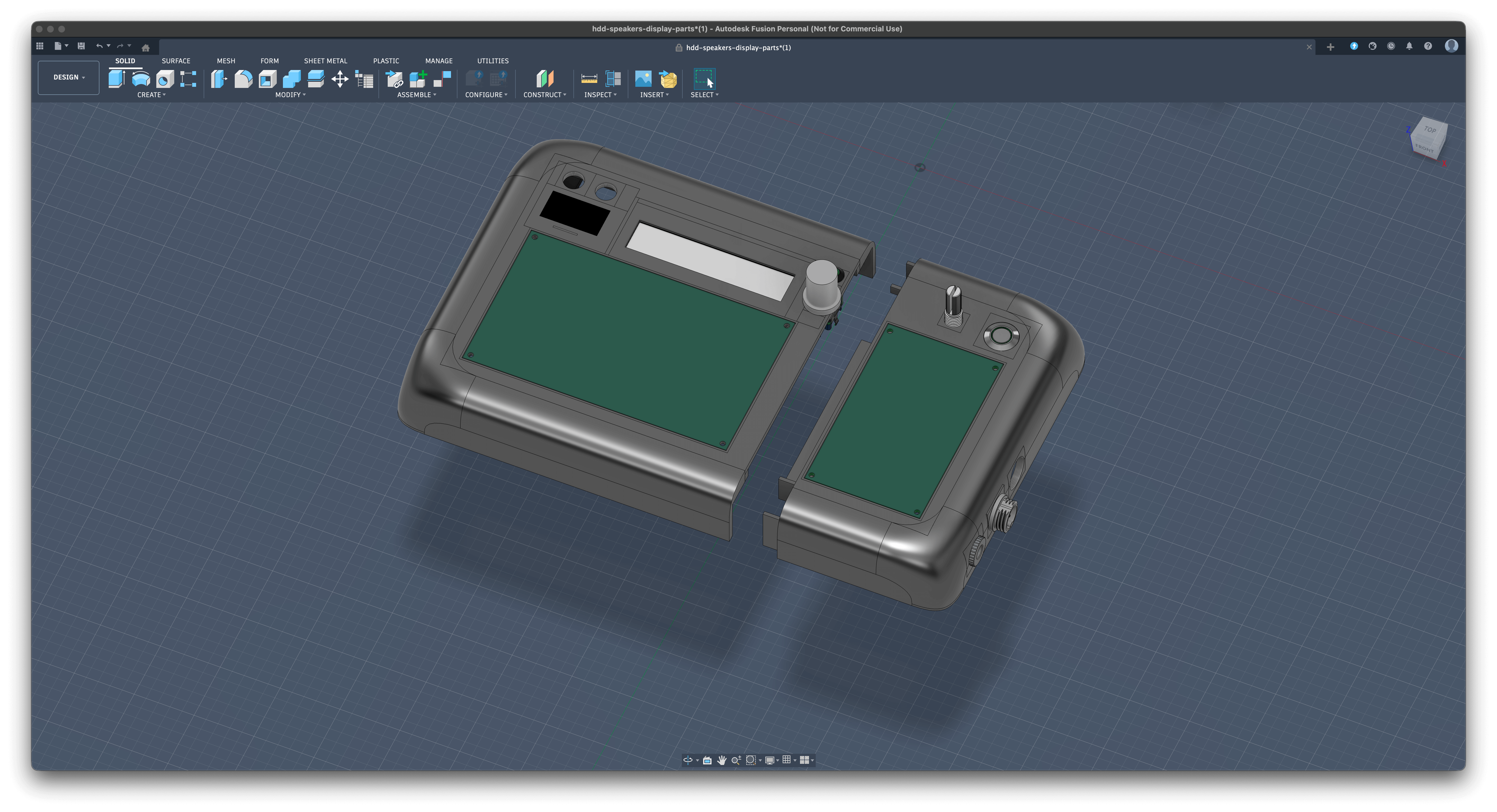
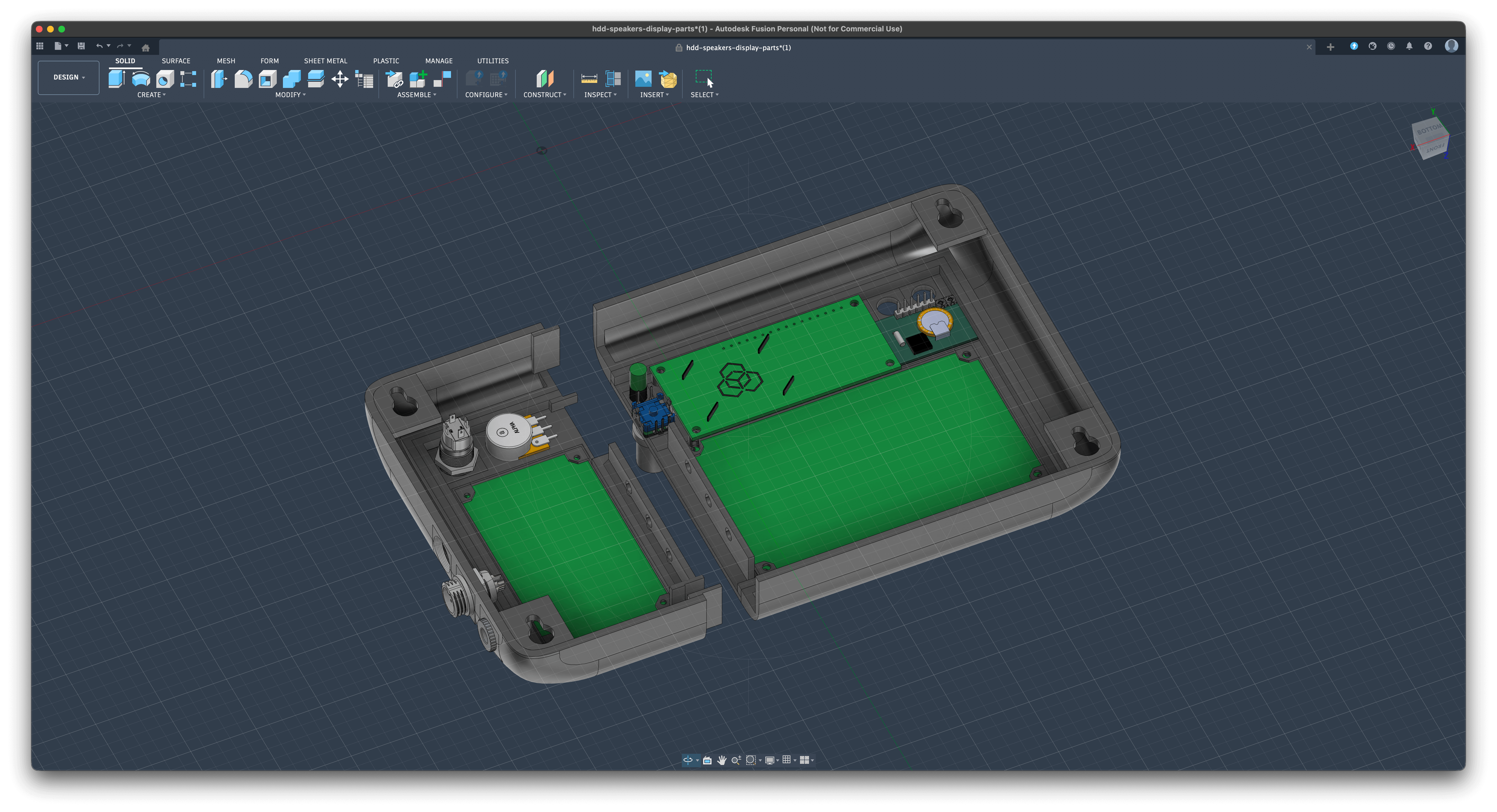
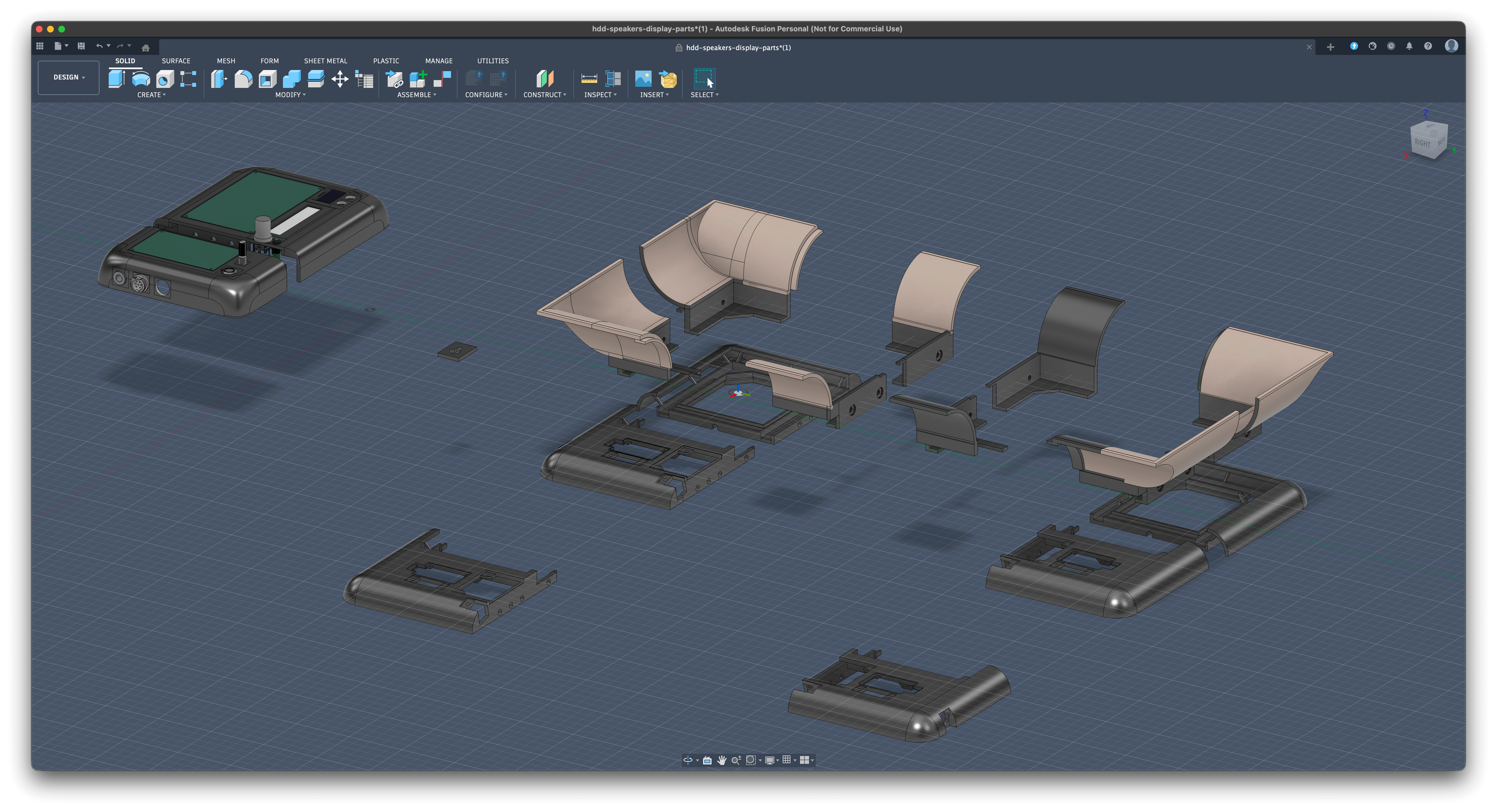
Later, 3D printed enclosures with a cleaner fit and attempted acoustics.
The enclosures were too large to print in one piece, so I split them into sections, connected them with screws hidden below the covers, and filled the gaps with black hot melt glue.
I ended up using four new Western Digital Caviar 500GB drives. Wanted them fresh, wanted them identical.
The crossover was necessary. A single drive coil trying to reproduce the full frequency range sounds thin and strained. Split the signal and each drive is doing something it can actually handle. And it looks cooler.
Hard drives ship sealed for a reason. The platters are mirror surfaces, microscopically precise, and completely intolerant of dust and finger smudges. Removing the lid and leaving them open was desirable, but wasn't an option. So the covers were replaced with acrylic. Now what was always spinning inside is visible.
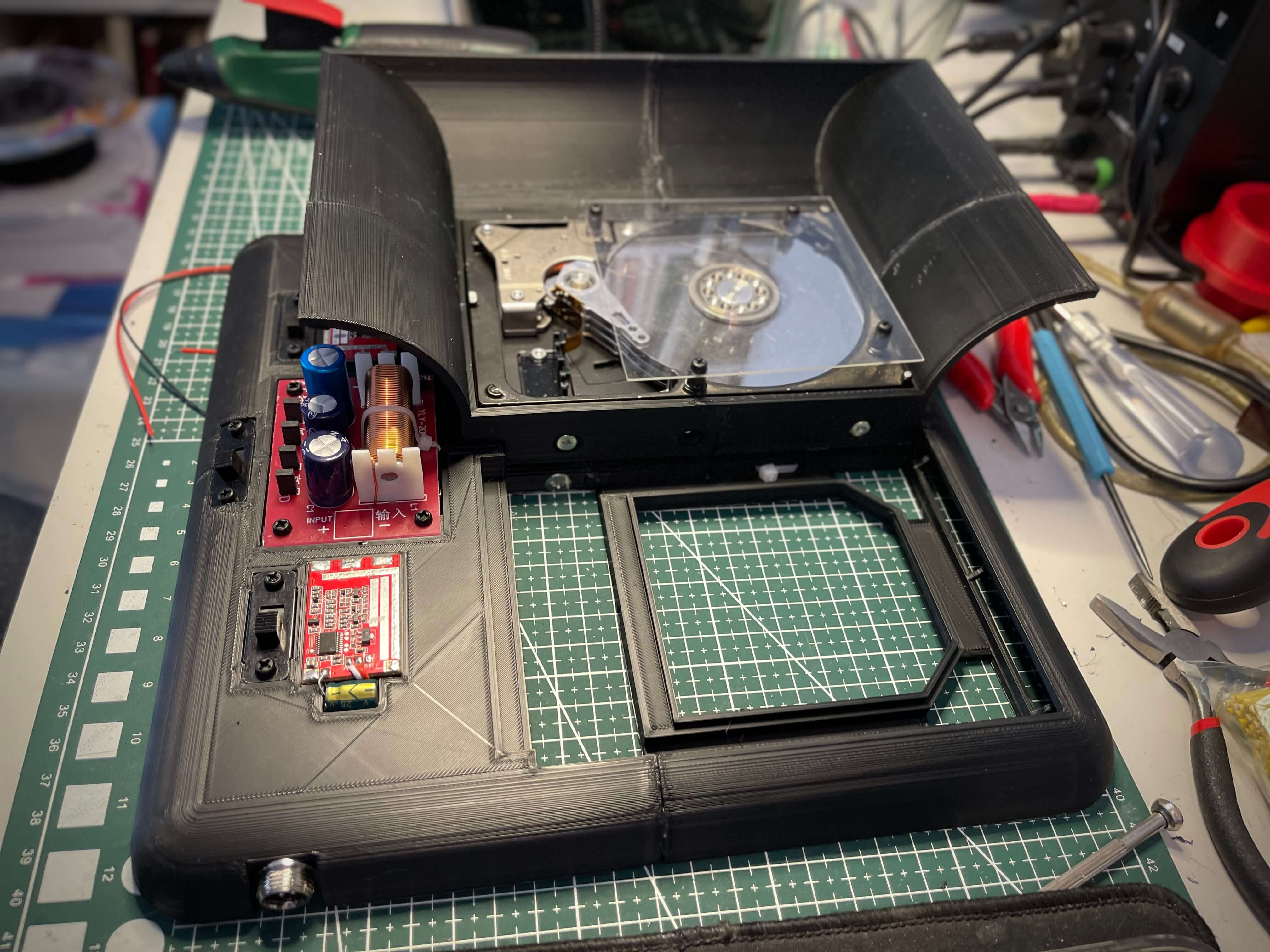
The platters rotate. This was the crucial part that elevated a curiosity into an art piece. They do not contribute to the sound, but complement the visual representation of music.
I wanted the platters to spin with the rhythm, back and forth.
To achieve that, the path was less obvious. One approach uses a sound card directly. Another uses a three-transistor circuit, which I tried. A third option: pair the motor with an ESC and deal with the consequences.
Getting there was harder than expected. Brushless motors are designed for one thing: high-RPM continuous rotation. Drone ESCs, RC car ESCs, any of them - give one a small pulse and it doesn't do a gentle nudge. It either screams or does nothing. The firmware has no concept of "a little bit clockwise."
The solution was in the PWM timing. Pulses just above the ESC's deadband, carefully tuned, short enough to produce a push rather than a spin. But this approach required a calibration step after power-up, and per-drive configuration of the thresholds. Four ESCs total: two per channel, independently responding to left and right peaks.
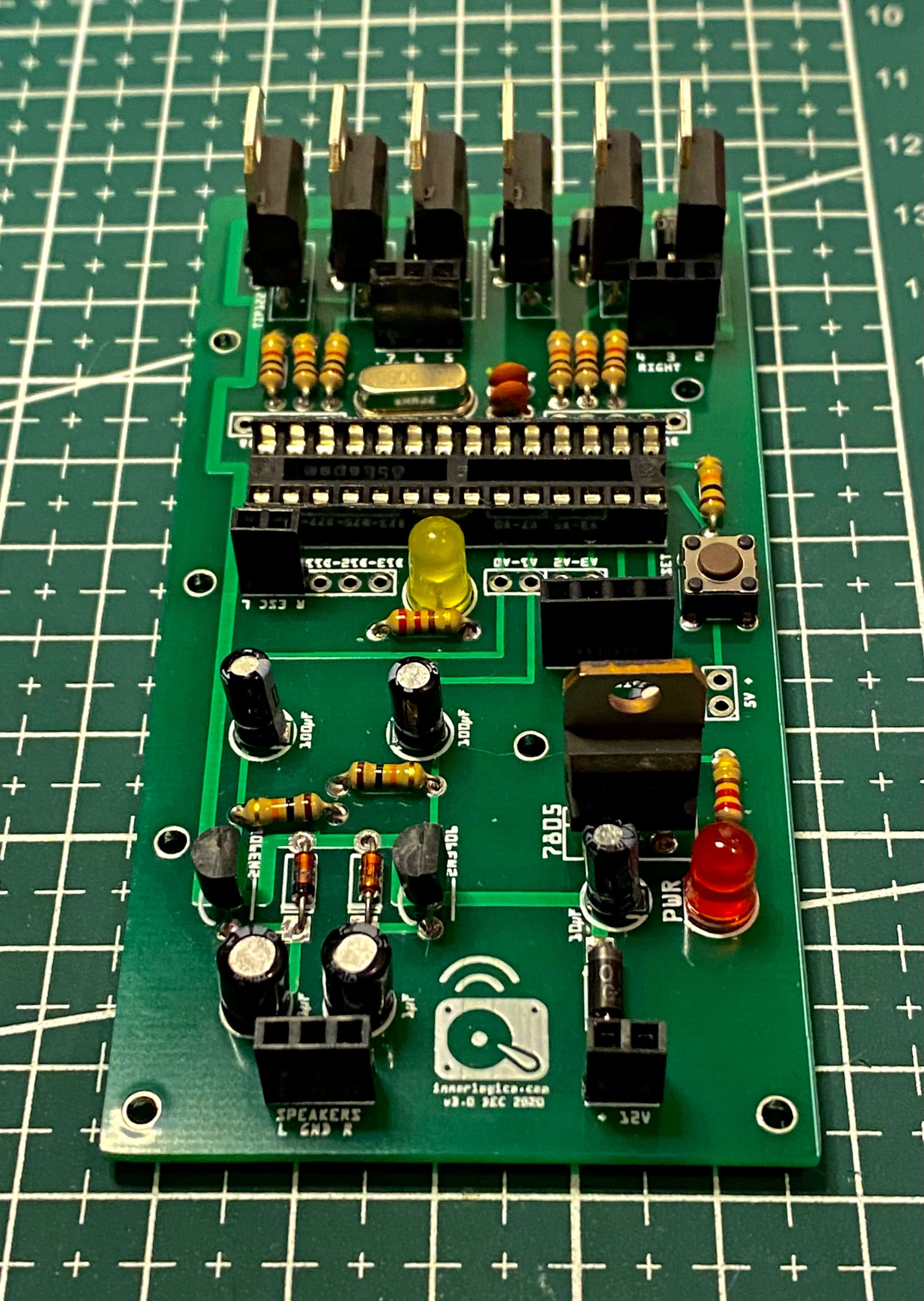
The peak detection circuit came from a 2014 blog post about frequency-to-voltage conversion. Five components: coupling capacitor, signal diode, PNP transistor, storage capacitor, resistor. Used here as an envelope follower: the output voltage tracks audio peak amplitude. The 100µF storage cap sets how long the peak holds before decaying, which is what determines how the platters respond to the rhythm. Two such circuits, one per channel.
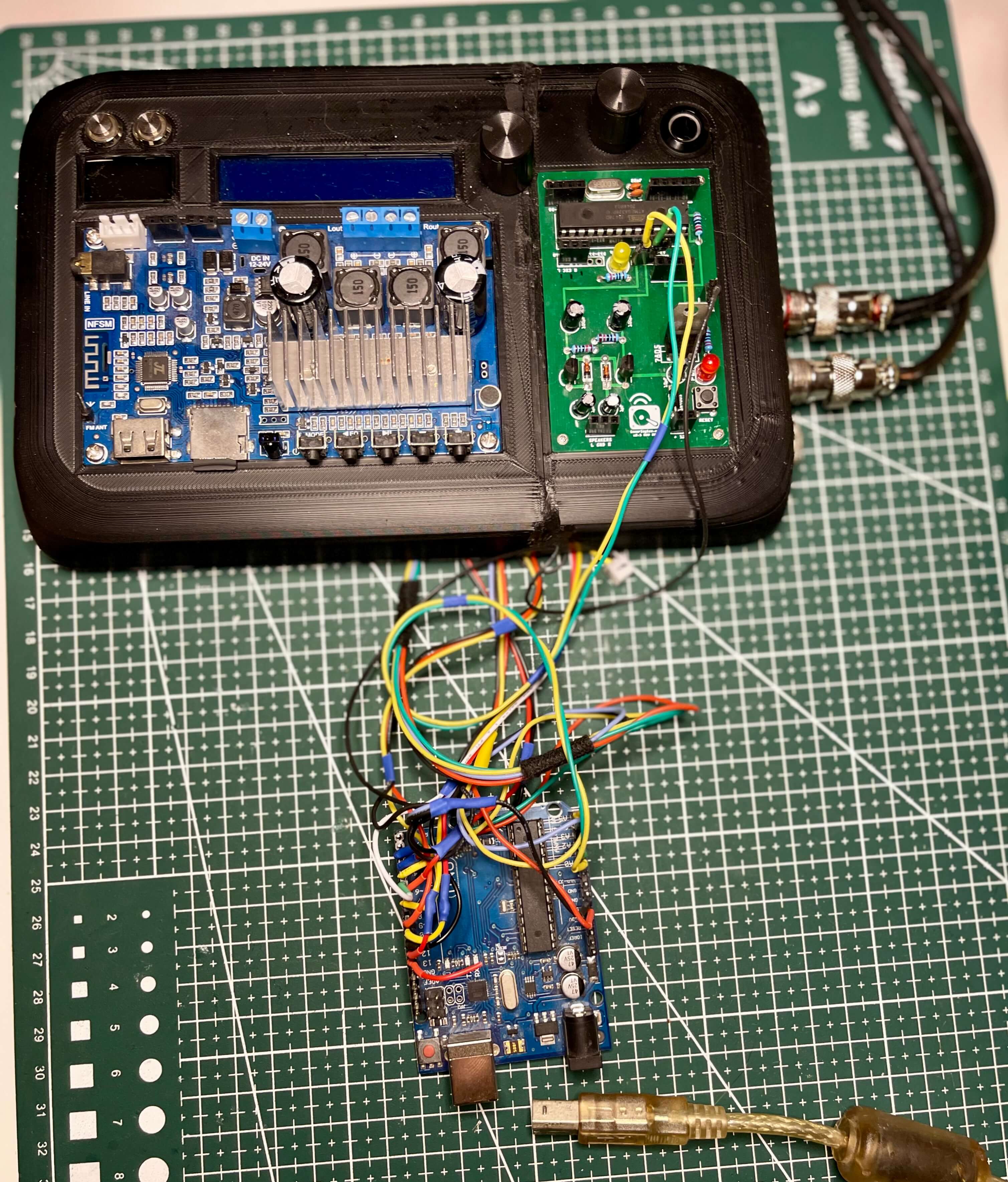
The controller went through three manufactured PCB versions. By the final revision, the ATmega328 was running nearly every pin: four ESC channels on PWM, two audio inputs on analog, rotary encoder with LED and button, 16x2 LCD over I2C, left and right indicator LEDs, and a heartbeat LED. One pin unused.
Everything connects to the wall panel through a GX16 7-pin aviation connector. One connector carries everything: left drive ESC signal, right drive ESC signal, ground, 12V, speaker positive and negative.
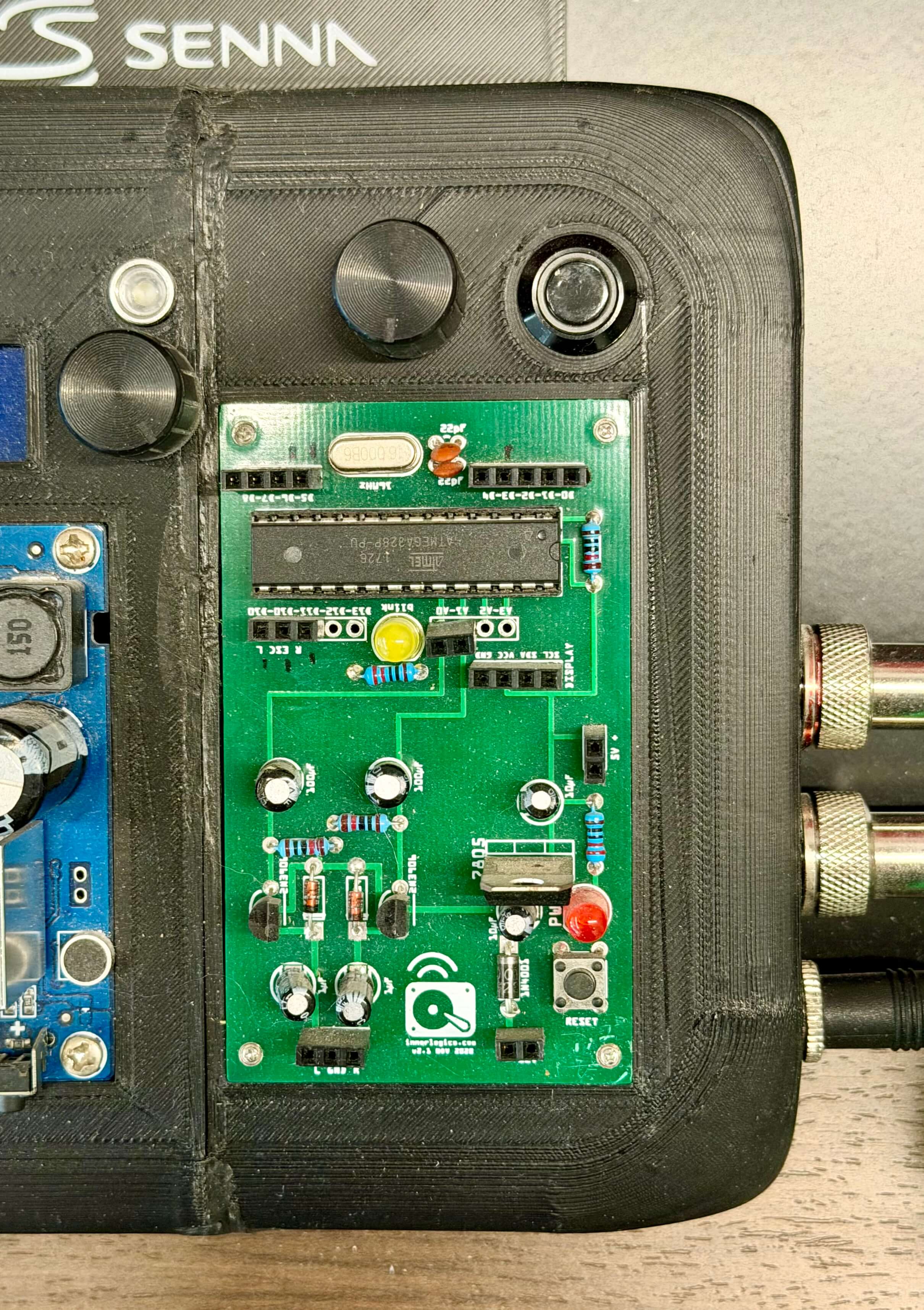
The build that's on the wall is not the first build. It's not the fifth.
The total across eighteen months of AliExpress orders is around $700. The two biggest line items are an oscilloscope and a lab power supply: tools that will outlast the project. Six amplifier boards tried before the TPA3116D2 2x50W Bluetooth-enabled board, the one that stayed.
Two crossover designs. Tried a TIP122 Darlington power transistors-based design because the ESC route seemed wrong, then ESC testers ordered because the transistor route actually was wrong. Springs and shock absorbers and passive woofer membranes tried as acoustic experiments, all abandoned. Phone loudspeakers tried as horns, abandoned. Roughly $140 went to buttons, switches, and controls alone, more than the amplifiers, more than the ESCs. The interface got more iterations than the audio chain.
Each dead end was a reasonable hypothesis at the time.
The controller lives separately, mounted to the wall next to the speakers. Bluetooth amplifier board, the custom PCB with an ATmega controller (the heart of an Arduino), a rotary encoder for configuration, the LCD showing left and right audio levels as a bar graph with custom characters, and a small OLED spectrum analyzer.
The spindles also turned out to be excellent for something unrelated to audio.
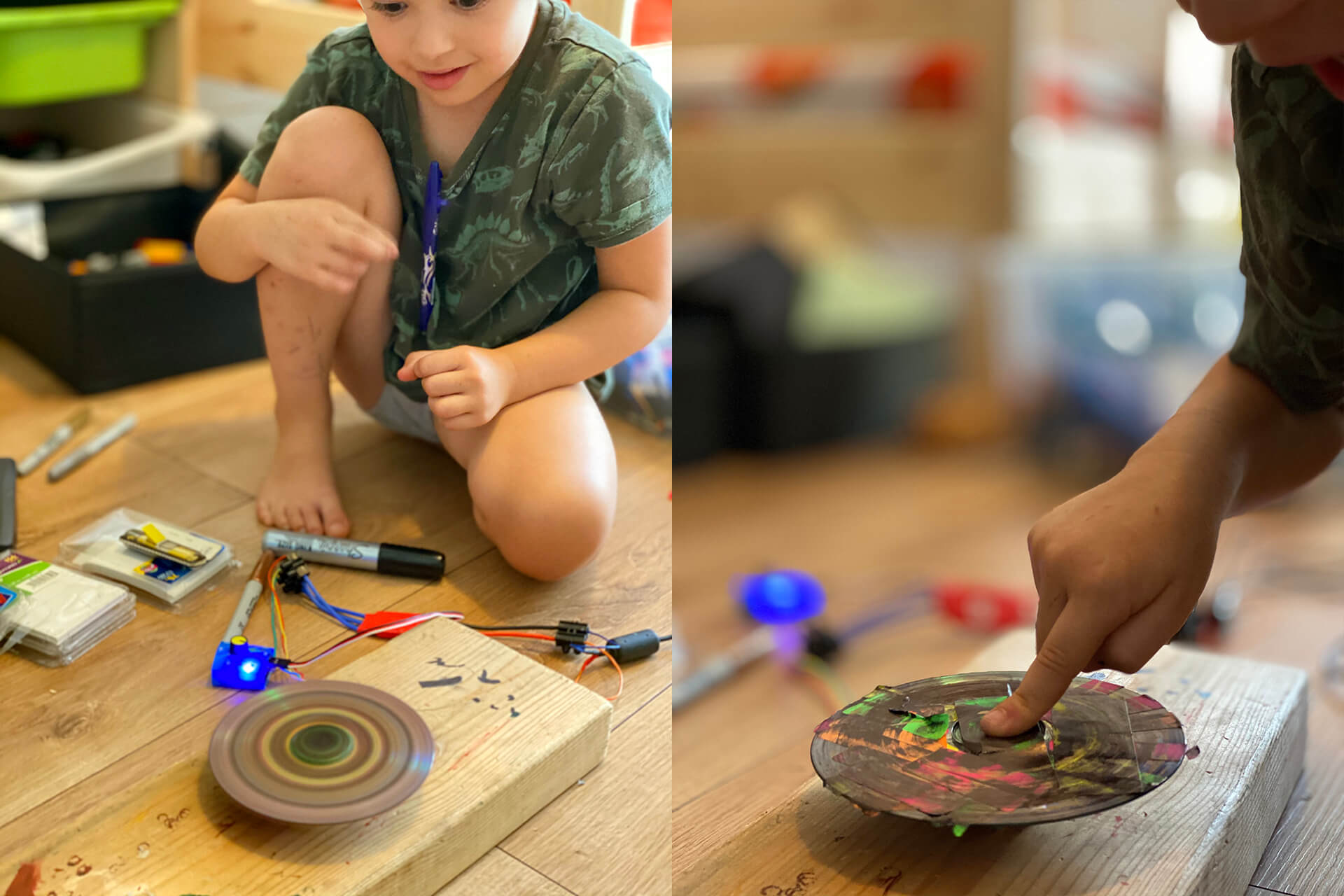
A Sharpie held against a spinning platter produces magical concentric rings. The kids figured this out (they also figured out it can accelerate LEGO wheels, and bounce off stuff thrown at it). The same ESC behavior that required so much tuning to produce a gentle rhythmic nudge was, at full speed, a perfect spin art machine. The platters that didn't make it into the final build got used for this instead.
The HDD hacking space is wider than it looks. PendoLux replaces the read head with a strip of WS2812B LEDs and drives the same voice coil back and forth fast enough to produce a persistence-of-vision clock display. The laser oscilloscope projects described on Make as far back as 2006 mount mirrors to the actuator arm and bounce a laser beam off them, with audio driving the arm and a spinning mirror on the platter providing horizontal sweep. Published research has used voice coil actuators as high-speed laser shutters, switching in under 10 microseconds.
And then there's the whole genre of hard drive and floppy drive music, which is its own rabbit hole.
The sound is not audiophile quality. The excursion is tiny, the frequency response is uneven, and the voice coil was designed for microsecond positioning moves, not sustained audio reproduction. But it is real sound, real stereo, from hard drives that reached their end-of-life.
And when the platters start moving with the beat, nobody asks how it sounds, but rather what's going on here, how the heck does this thing play music.
The schematics, designs and models are available on GitHub.
Released at the Assembly 1993 demoparty, it is widely considered one of the most influential demos in demoscene history and a defining moment in real-time PC graphics.
This video is an edit of Second Reality as heard through the Spin Doctor hard drive speakers.