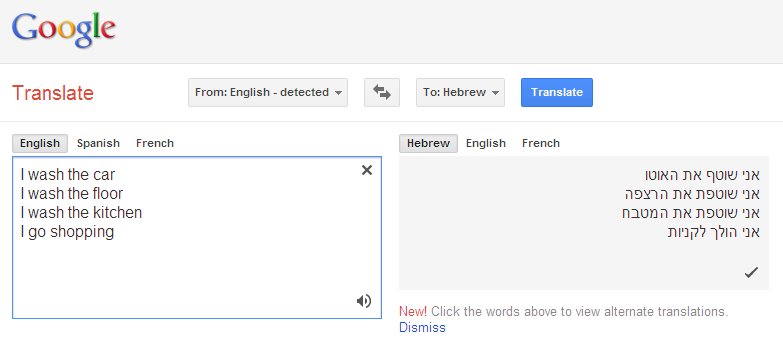
In November 2011, I ran four sentences through Google Translate. English to Hebrew.
The sentences:
I wash the car
I wash the floor
I wash the kitchen
I go shopping
Hebrew is a gendered language. Every verb has a masculine and a feminine form. The translator had to pick one.
It picked masculine for the car. Feminine for the floor. Feminine for the kitchen. Masculine for shopping.
The subject is "I" in all four sentences. The subject has no gender. The only thing that changed was the object.
I posted it to Facebook with the title מה את עושה מחוץ למטבח? The Hebrew idiom for "what are you doing outside the kitchen?". It's the kind of thing a certain kind of man says to a woman who has opinions.
Friends were quick to name it. Statistical sexism. And not just the kitchen. The floor gets the feminine treatment too. Both are inside the house.
It happens quickly-more quickly than you, being human, can fully process.
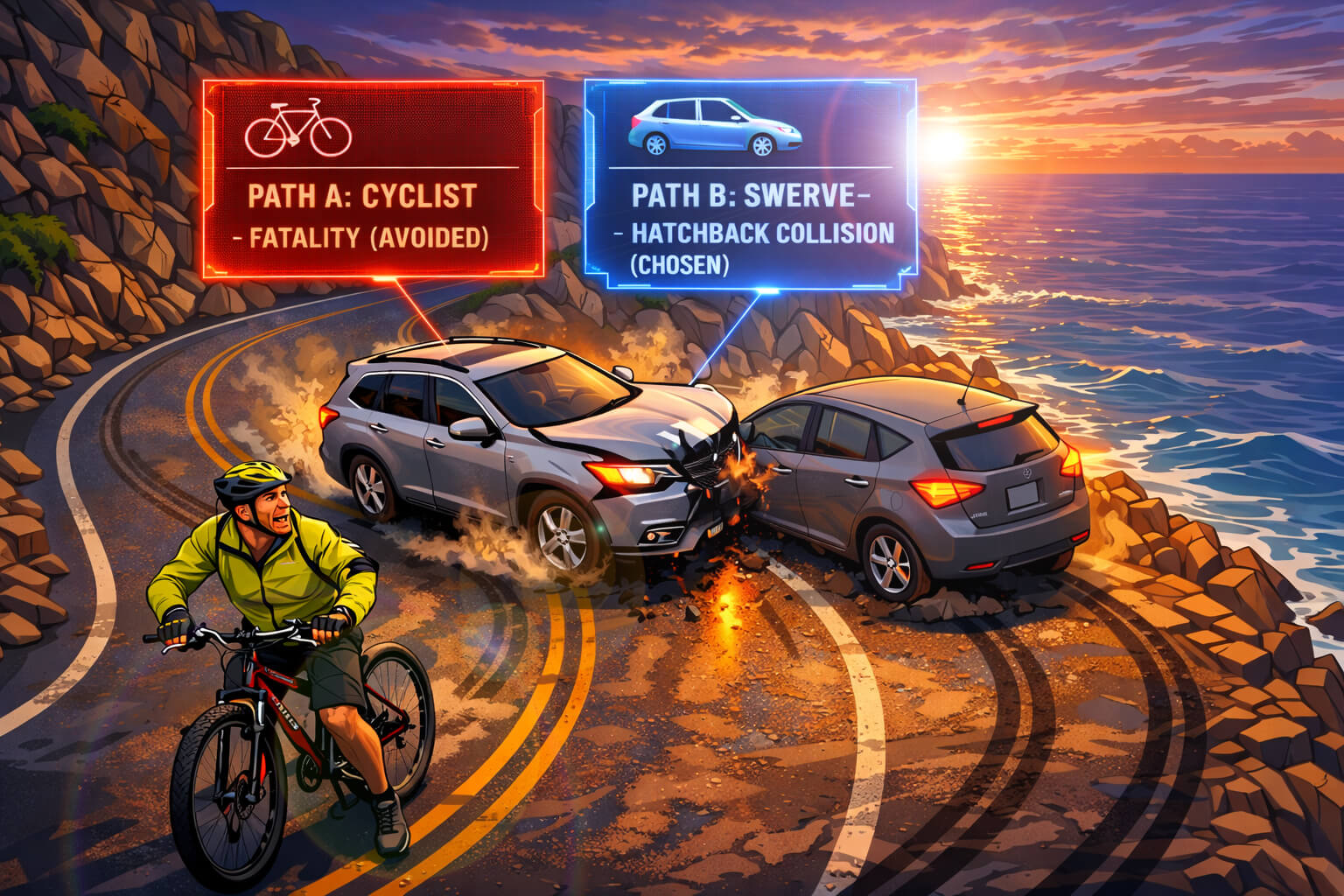
A front tire blows, and your autonomous SUV swerves. But rather than veering left, into the opposing lane of traffic, the robotic vehicle steers right. Brakes engage, the system tries to correct itself, but there's too much momentum. Like a cornball stunt in a bad action movie, you are over the cliff, in free fall.
Your robot, the one you paid good money for, has chosen to kill you. Better that, its collision-response algorithms decided, than a high-speed, head-on collision with a smaller, non-robotic compact. There were two people in that car, to your one. The math couldn't be simpler.
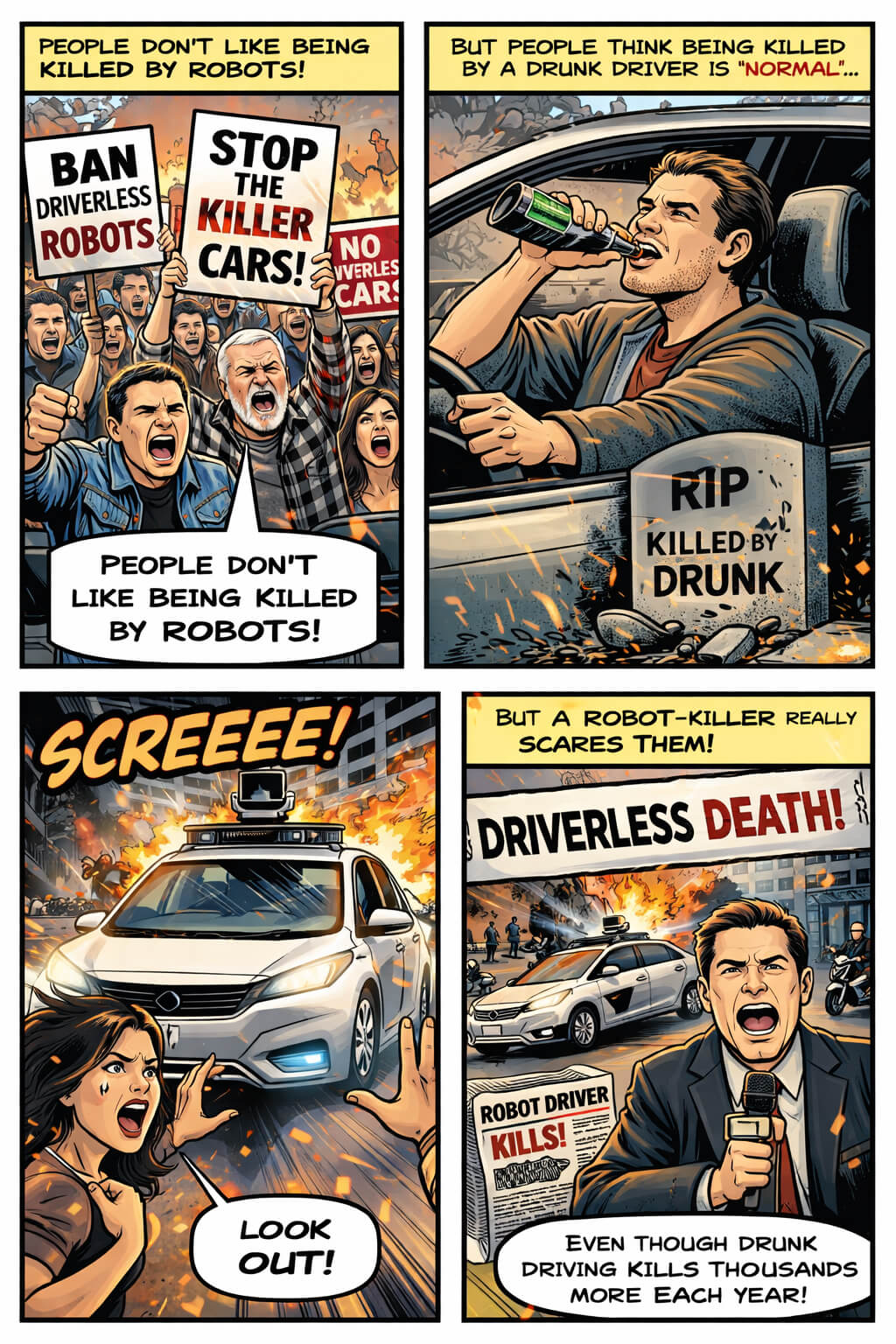
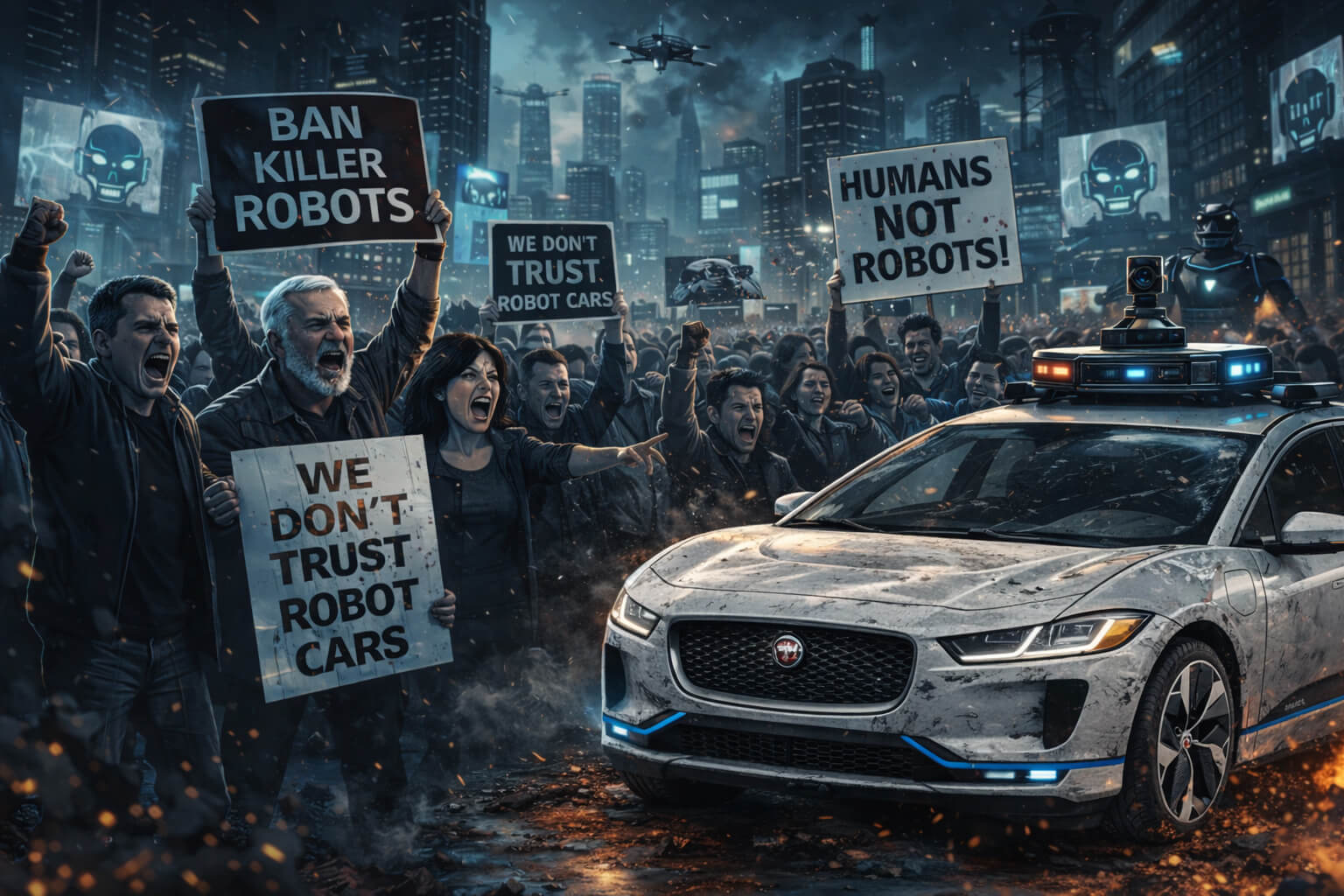
I usually hear about the safety aspects of driveless cars. After all, people don't like being killed by robots. Another intersting angle is ownership: what if I can pay for a car with a safety algorithm that prioritzes me, the owner, and my loved ones?
PZ Myers wrote an essay claiming that "Ray Kurzweil does not understand the brain", which has some good points, but is entirely based on the premise that Kurzweil says we will reverse-engineer the brain from the genome, that contains 25 million [relevant] bytes, or a million lines of code (second-hand comments on erroneous press reports, taken out of context).
I mentioned the genome in a completely different context. I presented a number of arguments as to why the design of the brain is not as complex as some theorists have advocated. This is to respond to the notion that it would require trillions of lines of code to create a comparable system. The argument from the amount of information in the genome is one of several such arguments. It is not a proposed strategy for accomplishing reverse-engineering. It is an argument from information theory, which Myers obviously does not understand.
The reasoning behind the "million lines of code" calculation makes sense if you think about the Kolmogorov complexity of the DNA responsible for coding the design instructions for building the brain.
Trying to reverse engineer a complete brain biologically, in order to have a computer simulate the same principles (only faster) is dumb. I've read Kurzweil's "How to Create a Mind", and he knows his shit. He gave specific examples of how his team gained some insights that helped improve speech recognition from reverse engineering several processes.
Mostly I think that in general the human population, myself included, is an incredibly stupid, short sighted, nasty, egotistic species with occasional streaks of artistic, political or scientific brilliance. Hopefully we can do better than simulate that.
Templeton serves as the Singularity University Networks & Computing Chair, as well as Chairman Emeritus of the EFF. He also consults for Google's driverless car team.
An acronym he used stayed with me:
PDLBKBR: People Don't Like Being Killed by Robots.
This, he said, is the "risk perception asymmetry". People would rather be killed by drunks.