Riding the Lightning with RaspiBlitz

I designed a 3D printed chassis for a standalone RaspiBlitz appliance.

RaspiBlitz is a DIY Bitcoin full node running together with a Lightning node on a Raspberry Pi with a touchscreen display. It was created by developer Christian Rotzoll and is backed by Fulmo, a Berlin-based Bitcoin startup that runs Lightning Network hackathons worldwide.

Running your own Bitcoin node means you don't have to trust anyone else as your source of truth. If you accept Bitcoin payments through someone else's node, that data can be spoofed. "Not your node, not your rules", as the RaspiBlitz docs put it. It's the infrastructure layer of financial self-sovereignty.

The Lightning Network runs on top of the full node as a second layer for fast, low-fee payments. Still experimental, but plenty of people are running it anyway out of enthusiasm and a desire to push the network forward.

Named my node Barracuda, a play on the words Barak (ברק) and Lightning.

There were a few non-obvious gotchas. The initial Bitcoin blockchain sync takes days, not hours. A Lightning channel can only be opened after that sync completes. Finding good peers and covering the on-chain fees for opening channels was more involved than expected. To receive Lightning payments, you also need inbound liquidity, channel capacity on the remote side. You can buy funded channels or use a looping service to rebalance. In total, my node forwarded 335,497 sats, for a 21.6 sat fee.

Update, June 2023: For gaining some hands-on experience with Lightning, I established a few channels and sent transactions between my node and a wallet hosted on BlueWallet's LNDHub. They apparently shut down the service, and users were expected to move funds out by end of May. I didn't get the memo. I filled out a form, but have little hope. Yet another reminder - not your keys, not your coins.
Components

Read more →

Elementary School 3D Printing Presentation

A companion video for a 3D Printing lecture I gave at my kids' elementary school.

0:00:00 - Printing Baby Yoda (while setting up; special guest appearance: Mongo)
0:00:47 - How a 3D printer works
0:01:17 - Printing toys at home (computer modeling, printing, assembly)
0:02:54 - 3D printing food: pizza
0:03:23 - 3D printing food: vegan steak
0:03:49 - 3D printing food: maybe in the future we could print whatever food we want?
0:04:27 - 3D printing food: chocolate and candy 🍫
0:05:30 - Giant printers: printing a boat 🚤
0:05:51 - Giant printers: printing a house 🏡
0:07:05 - 3D printing on another planet: NASA's competition to 3D print a base on Mars
0:08:02 - 3D printing in medicine: replacement parts for the body
0:08:37 - 3D printing in medicine: prosthetics
0:09:22 - Nano-printing: printing a castle on the tip of a pencil ✏️🔬
0:10:51 - A few examples of objects we designed and printed at home

Read more →

Block Zero

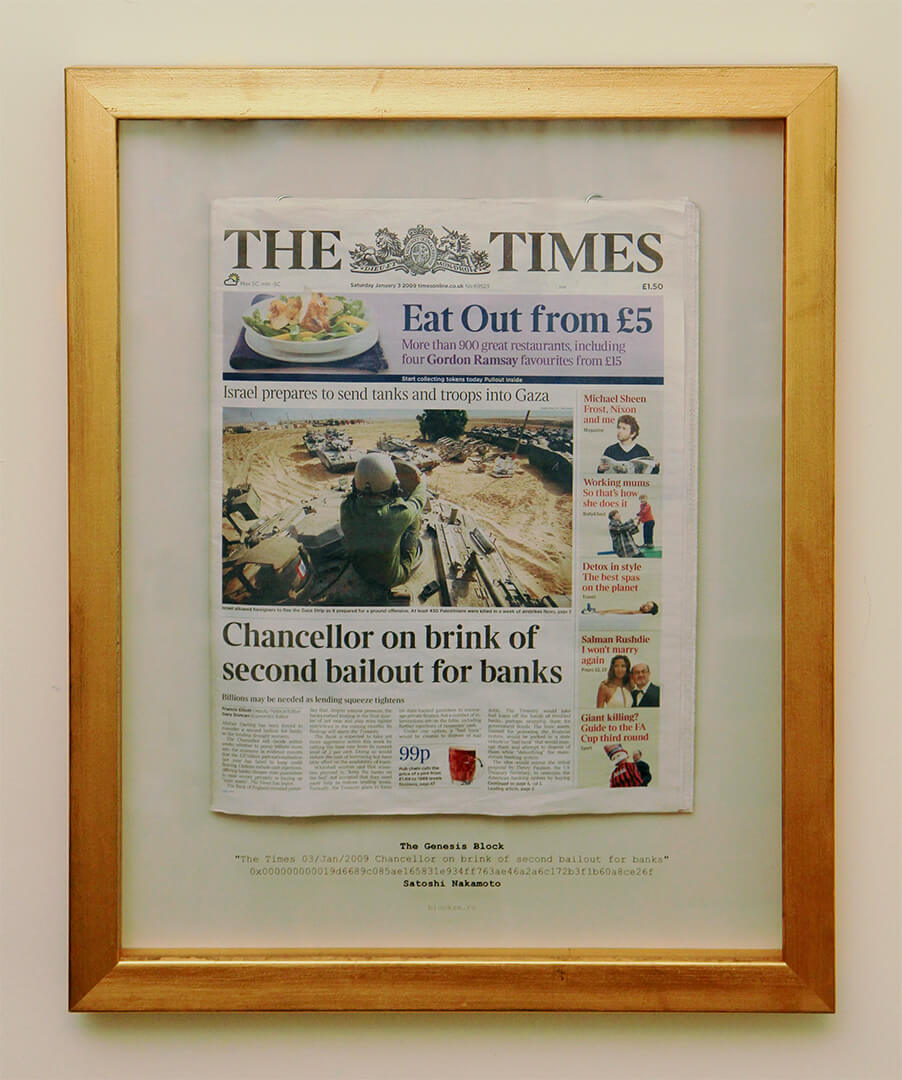
Ten years ago today, Satoshi Nakamoto mined the genesis block, embedding a headline from The Times into Bitcoin's first transaction: "Chancellor on brink of second bailout for banks". Timestamp and thesis in one sentence.

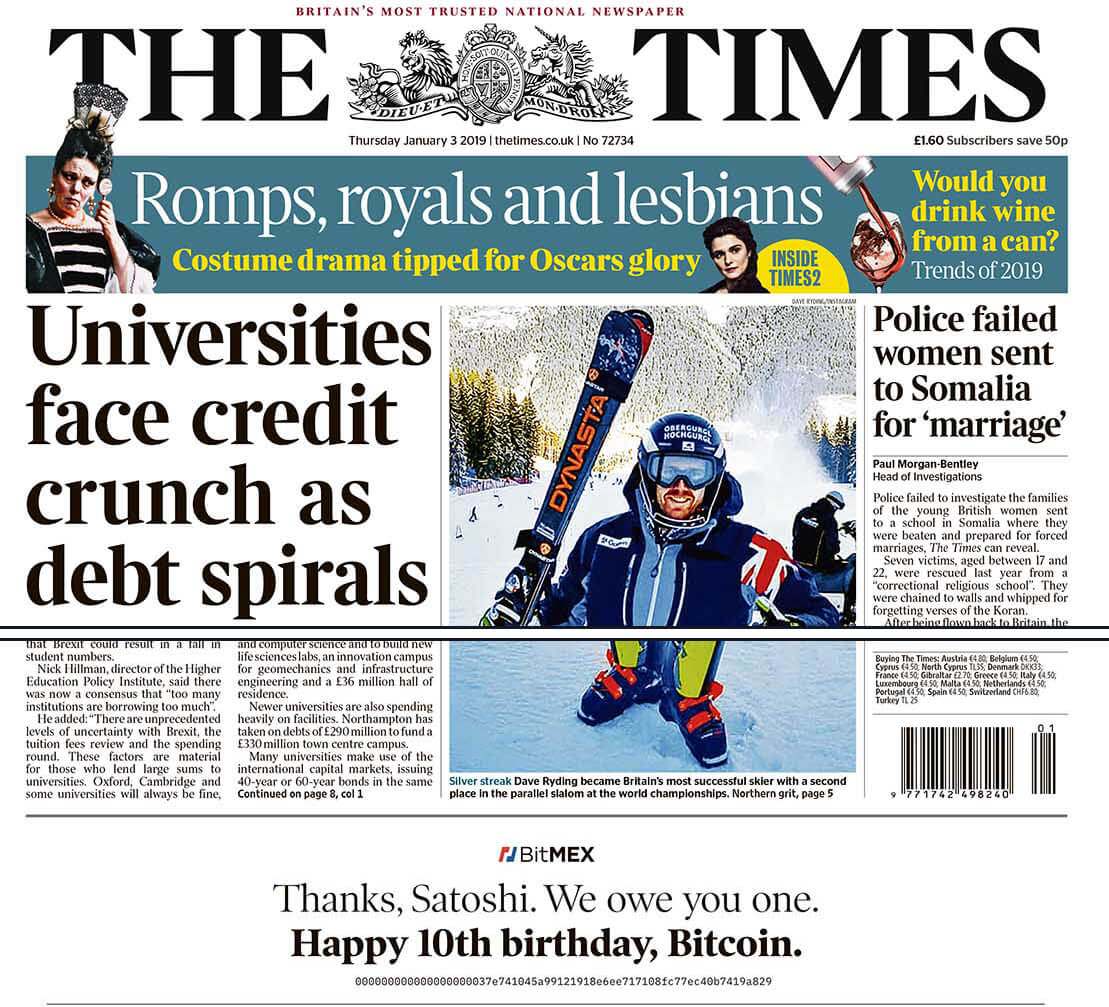
To mark the anniversary, BitMEX took out a front-page ad in that same paper reading: "Thanks Satoshi. We owe you one. Happy 10th Birthday, Bitcoin". Fitting, too, that today's lead story in that paper is "Universities face fresh credit crunch as debt spiral".

In 2009, Chancellor Alistair Darling was considering a second £37 billion injection into British banks. Satoshi responded by launching a system that doesn't need bailing out.

Five years ago, I tried to get my hands on original copies of that edition. Three came from Historic Newspapers, ordered in December 2013. A fourth came from Bygone News in January 2014 - the last copy they had. The fifth came through Bitcointalk. A UK seller named jonny1000 had posted his copy on January 3rd, 2014, Bitcoin's fifth anniversary. He'd originally listed it at 0.1 BTC. By the time he'd finished calling the archive services to try to source more for buyers, the price had changed. He called three companies. All three told him January 3rd, 2009 had sold out in the last few days due to, as he put it, "something to do with Bitcoin and extremely high demand".

The scramble was widespread. GettingPersonal couldn't source copies after multiple follow-ups. Papers Past found two copies but they were the Scottish edition. I paid 0.589 BTC for jonny1000's copy on January 30th - roughly $470 at the time - with shipping to Tel Aviv included. He e-mailed me a photo of his driving license next to the newspaper with my name written on a note before I sent the transaction. It arrived via Royal Mail a week later.

Read more →

We Won Israel's First Bitcoin Hackathon!

Six weeks ago Bitcoin was at $266. Then it wasn't. Then it was $60. Last Thursday it was $120. We keep enjoying the ride. Bitcoin 2013 had just wrapped in San Jose. The whole conference was called "The Future of Payments". Gliph launched there with Bitcoin built into their messaging app.

eToro hosted "Israel's first Bitcoin hackathon". 48 hours, 45 people, their offices at Ramat HaHayal in Tel Aviv. Bring an idea, pitch it in 3 minutes, form a team, build a prototype, present Saturday evening. Everyone votes.

eToro wasn't just providing a room. Yoni Assia had been writing publicly about Bitcoin and programmable money for years. This is a company that actually believes in this.


Thursday night, Moran Shaked pitched ₿uy The Way.

The idea: you're walking past a store, see a 2-for-1, message your friends with the details and a payment request. The ones who want in click the button, Bitcoin is sent, you buy two. No IOUs. The mechanic wasn't the payment - it was the ask. Initiating a request tied to a real-world opportunity. Movie tickets for the group. Splitting a meal. A flash sale your friend would have missed.

"Where friends & money are even for a change."

We teamed up. Spent the next 36 hours building a POC. We wanted the demo to show the flow end-to-end: spot an opportunity, create a request, share it, collect payment.

This was Moran's first hackathon. She'd been following Bitcoin since early 2012 but isn't a developer. She came with an idea and the ability to make a room understand why it mattered.

Programming money feels different from programming anything else - you write code, real-world assets move. No bank in the middle.

Saturday at 18:00, each team presented. The crowd voted on three criteria: contribution to Bitcoin promotion, creativity, how finished the product was.

₿uy The Way won.

2 BTC + $1,000 eToro balance each.

Social payments exist. What doesn't yet is the ask that starts with a buying opportunity - you see something, you pull friends in, payment clears before you buy. No more asking your friend for that money back.

Now wondering how long before WhatsApp just adds a "₿uy The Way" button.

Read more →