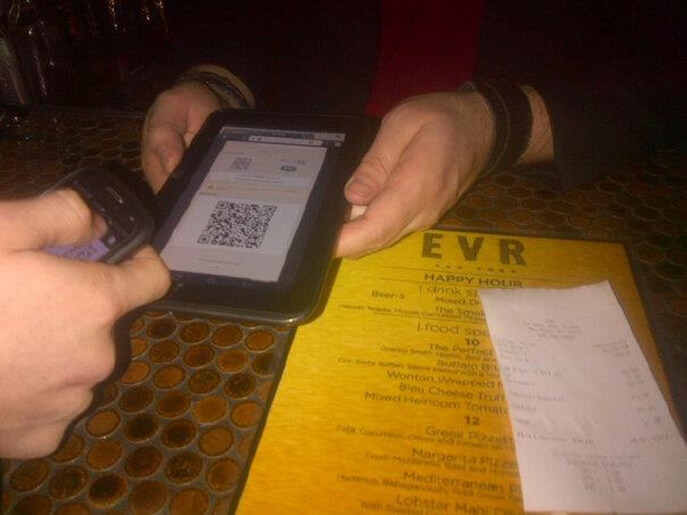
I'm in NYC for a week, returning home tomorrow, and just got back from the EVR club. I'm a bit too old for a Friday-night dance club, and the $100 minimum bar tab was a little ridiculous, but I'm glad I went, helped the Bitcoin economy a bit, and gained some first-hand experience.
It was really funny on the way in. The bouncers didn't know what I was talking about, and they referred me to Alex (a different one, not the owner), who smiled and told them "oh, it's this Bitcoin thing that Alex is doing", then took me inside and whispered something into the radiant bartender's ear and told me she'd take care of me.
The payment process was smooth. Alex was so geeked out, I guess, that he asked someone to take a picture of us when I came to pay the bill. I just scanned a QR code off his tablet using my blockchain.info wallet app. I only had like 0.43BTC on me (worth about $60) so I paid the rest with my credit card, which actually took longer to process.
Still on a Hofstadter kick. It's Pi Day. Turns out they connect.
Starting at position 762, the decimal expansion of pi goes: ...999999... Six nines in a row.
This sequence is informally known as the "Feynman point." The story goes that Feynman wanted to memorize pi up to that spot, recite all 762 digits, hit the nines, and say "nine nine nine nine nine nine and so on".
Except it probably wasn't Feynman. The earliest known source is Hofstadter, in Metamagical Themas (1985):
I myself once learned 380 digits of π, when I was a crazy high-school kid. My never-attained ambition was to reach the spot, 762 digits out in the decimal expansion, where it goes "999999", so that I could recite it out loud, come to those six 9's, and then impishly say, "and so on!"
Before position 762, no digit in pi's decimal expansion appears more than three times in a row. Not four. Not five. The first time any digit manages four consecutive, five consecutive, or six consecutive appearances, it's nines. All at the same spot. A genuine mathematical coincidence.
And the joke only works with 9s. "...four four four four four four and so on" means nothing. Only 9s suggest the number is rational. Which it isn't. Which is the joke.
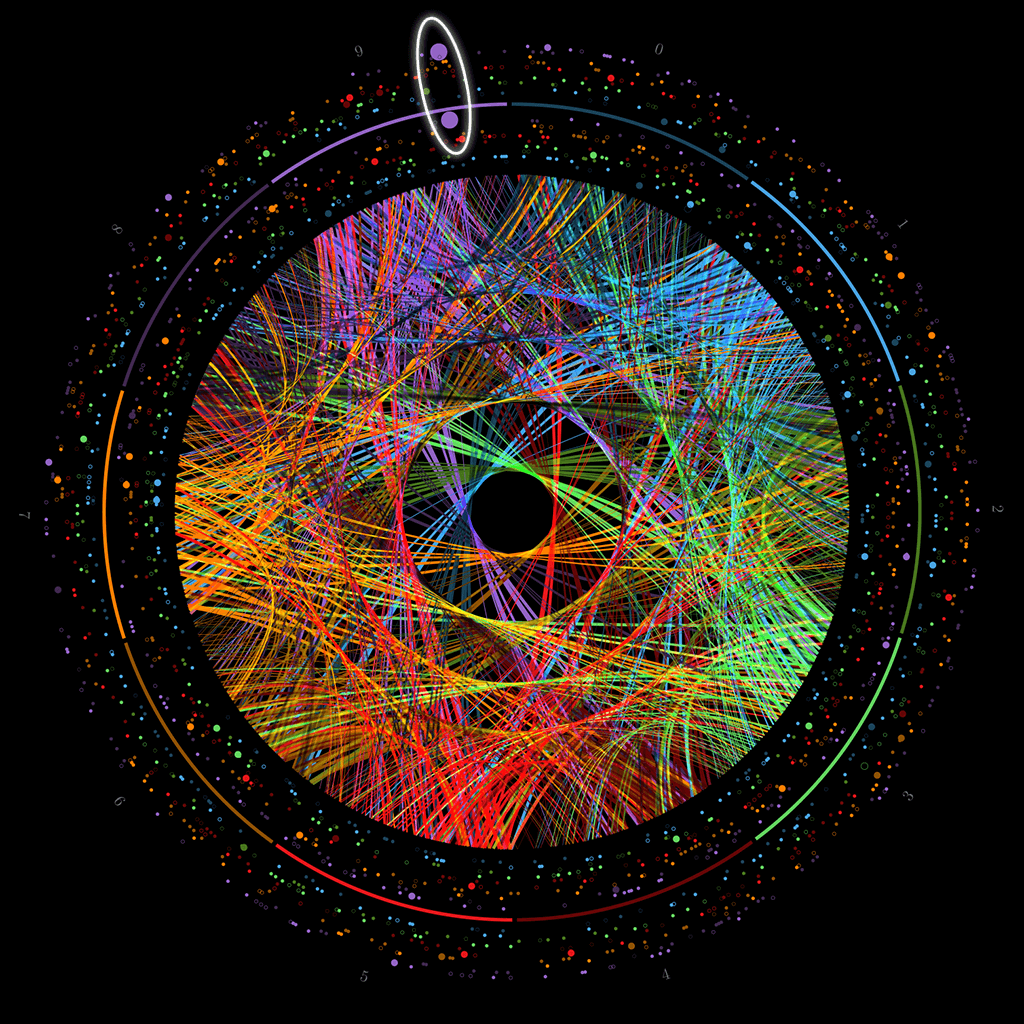
Update, October 2013: I stumbled upon this beautiful visualization by Martin Krzywinski. It's a circos diagram where the circle is divided into 10 segments (digits 0 through 9), and each digit of pi connects to the next with a line. The outer layer tracks transition counts: how often one digit follows another. Bigger dot means more frequent transition. The six consecutive 9s (999999) create five 9→9 transitions. In a circos transition diagram, each transition is recorded at both ends: the source and the destination. Since both the source and destination are the same segment (9→9), you get two large bubbles on the 9 segment, one for outgoing and one for incoming. Five transitions in quick succession inflates both.
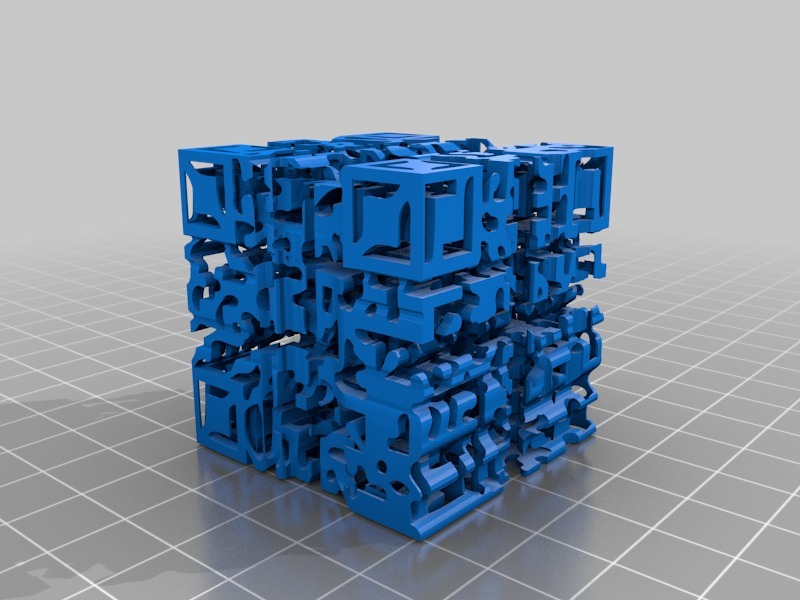
I found it on Thingiverse. A 3D-printable cube whose shadow, depending on the direction of the light, casts three different QR codes. Each one links to a Wikipedia article. Gödel.Escher.Bach.
The designer's note: "Note that QR codes cannot be read in mirror image, so only 3 of the 6 possible cube orientations cast a readable shadow".
I stared at this for a while.
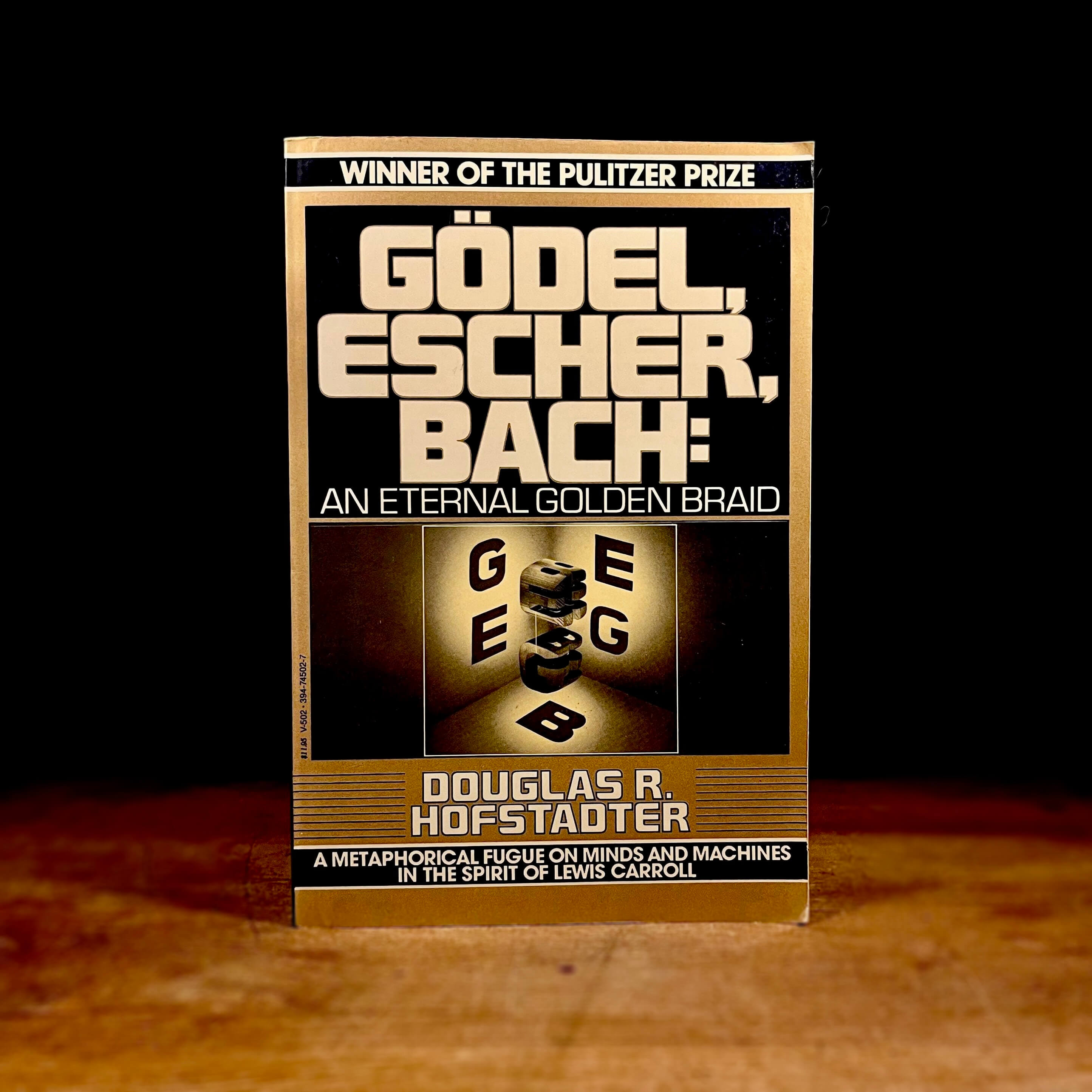
Hofstadter wrote, in the Introduction to GEB, that he eventually realized Gödel, Escher, and Bach "were only shadows cast in different directions by some central solid essence". He tried to reconstruct that solid. The book was the result.
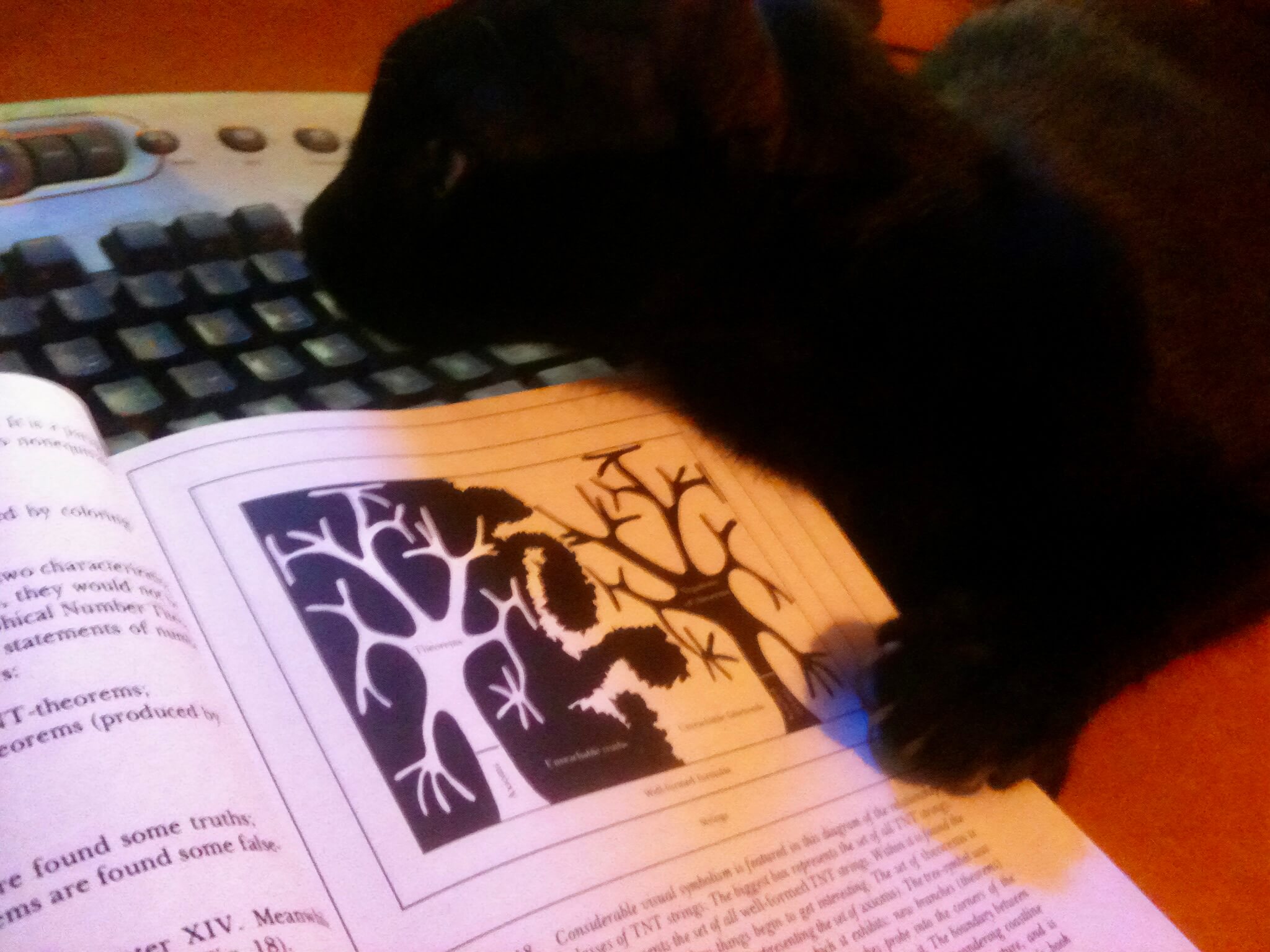
I read GEB in 2011. It took me ten months. The book is 777 pages and doesn't let you skim. Except for the chapter that's just diagram after diagram of visual pattern puzzles. I skimmed that one.
Formal systems. Strange loops. What it means for a system to talk about itself. The idea that meaning isn't carried in symbols. It emerges when one structure gets mapped onto another, when a decoder shows up and suddenly the marks mean something.
The concepts came fast and kept compounding. I'd finish a chapter and feel like I'd been handed new eyes. Then the next chapter would use those eyes to see something else.